
Bracknell Town have experienced an extraordinary turnover of players since the close of last season. With squad building continuing deep into the autumn, the constant churn raises structural questions: is it a case of unhappy players departing, or a ruthless recruitment strategy of evaluation and discard?
From an outside perspective, the recruitment model resembles gold prospecting - continually sifting through the silt rather than developing rough diamonds. While a high-churn strategy aims for continuous upgrades, ten games into the Southern Premier League South campaign, it is worth examining how this volatility impacts performance on the pitch.
The following figures are based solely on league games.
Recruitment
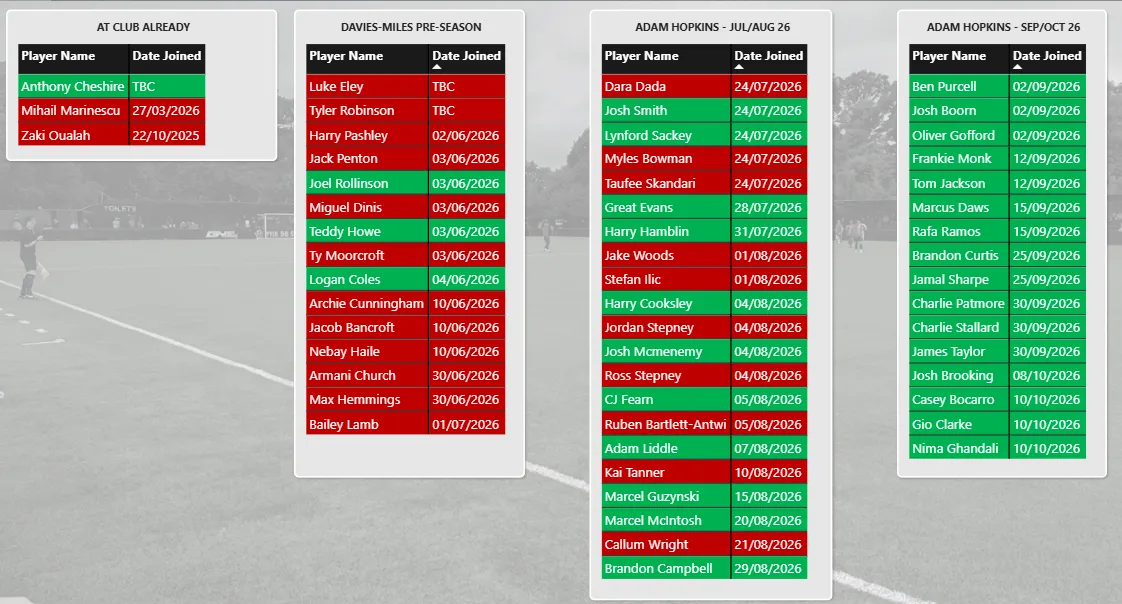
Piecing together club announcements and match sheets reveals a staggering scale of recruitment. Bracknell retained only 3 players from the end of last season’s squad before rushing to assemble an initial pre-season group.
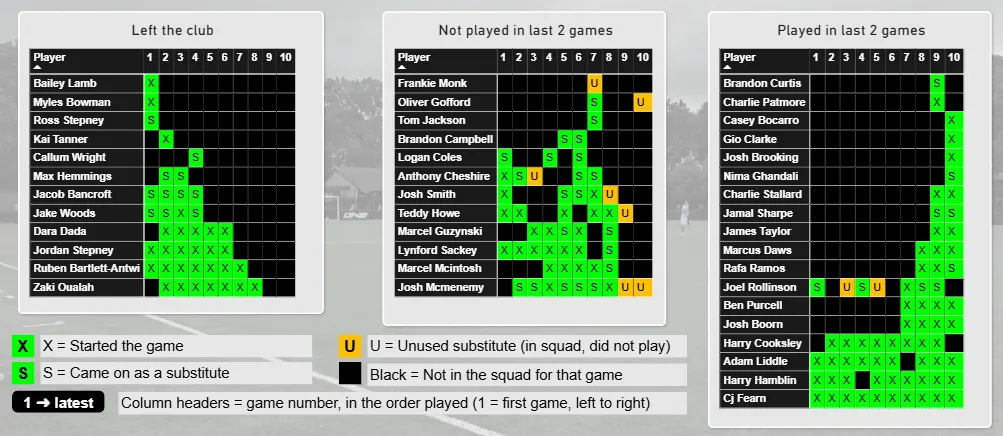
What remains appears to be a 31-man squad. There are some known injuries e.g. Great Evans and Tom Jackson but it’s unlikely all 31 are still with us or will be with us shortly. The middle table below shows players who have played for Bracknell this season in the league but have not played in the past two games. It’s likely some have left from this middle table but it’s not been confirmed yet.
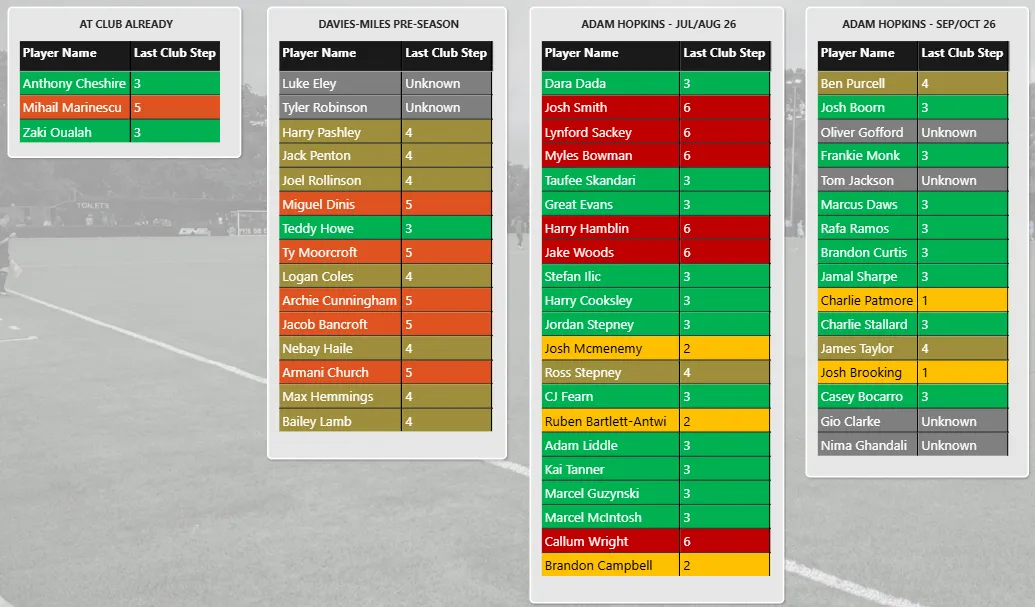
I’ve tried to keep a record of what step/team recruited players have come from to get a rough sense of their level. This has been hard to pin down and I am sure has errors but hopefully indicates the pools we’ve been recruiting from. It’s clear that the immediate draft of players in early pre-season was from Steps 4 and 5 - aligning with the sustainability message. Following a managerial change in pre-season, recruitment shifted toward Step 3 players and familiar faces from the new manager’s former club, Yateley. Under the current manager there appears to be a constant cycle of looking to upgrade on existing players.
Efficiency
The sheer amount of time and energy expended searching, negotiating, and managing dozens of players in and out could arguably be channelled elsewhere, particularly when the club’s key message is sustainability. Furthermore, signing an injured Great Evans in July, who was sidelined until November, appeared a puzzling move. It may be that he is a great (no pun intended) character around the dressing room. However, while dressing-room dynamics matter, it seems an odd move for a club looking to be sustainable and efficient.
Volatility
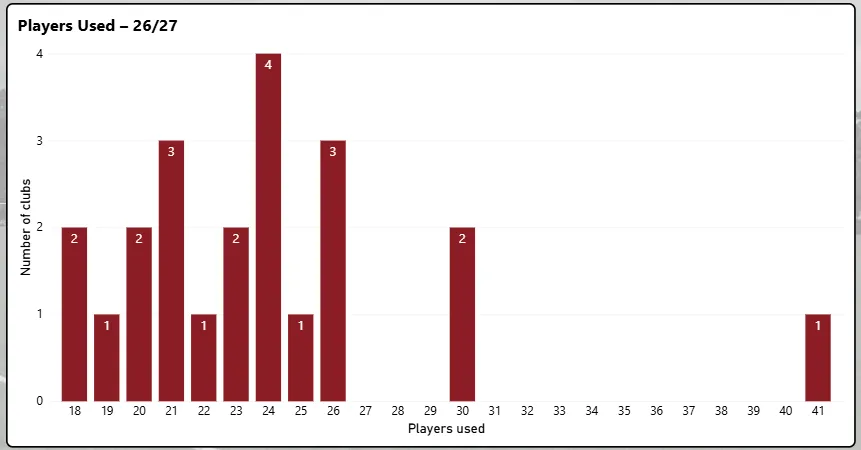
This high-frequency recruitment has driven exceptional squad volatility. In the opening 10 games, Bracknell have used a league-high 41 different players.
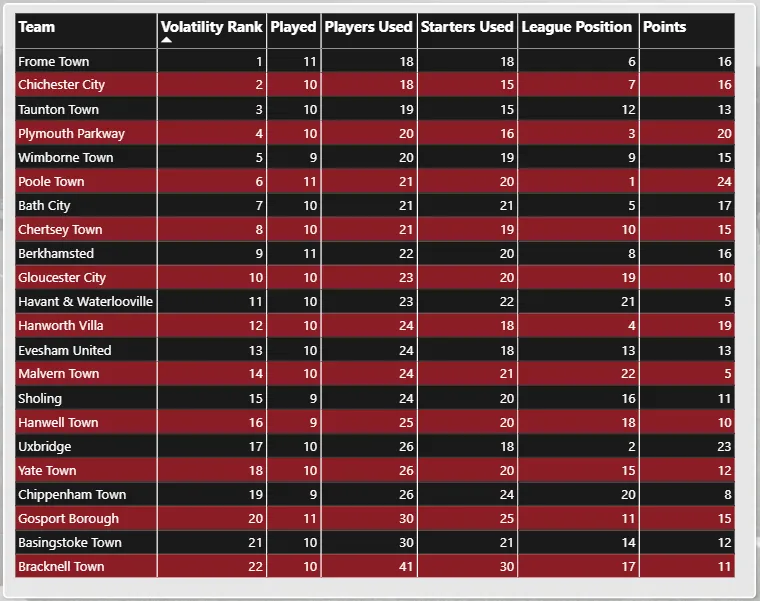
Typical clubs in the division utilise between 18 and 26 players over the same period, leaving Bracknell as a stark statistical outlier.
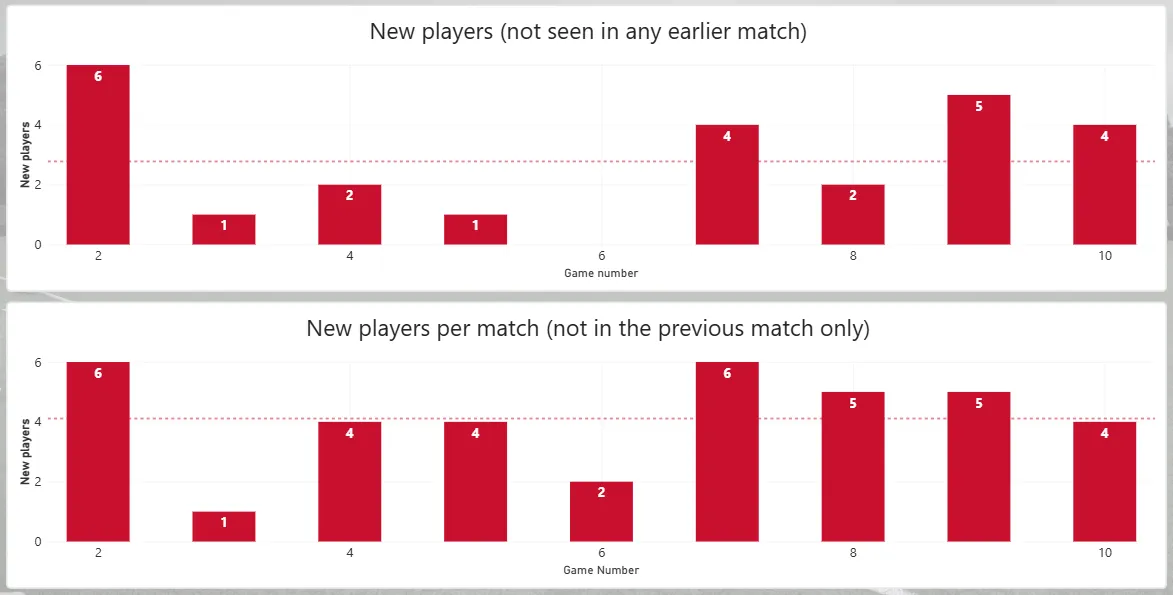
The change of line-ups game-on-game can also be seen below. On average, the team introduces 4 new players per match who did not feature in the previous fixture.
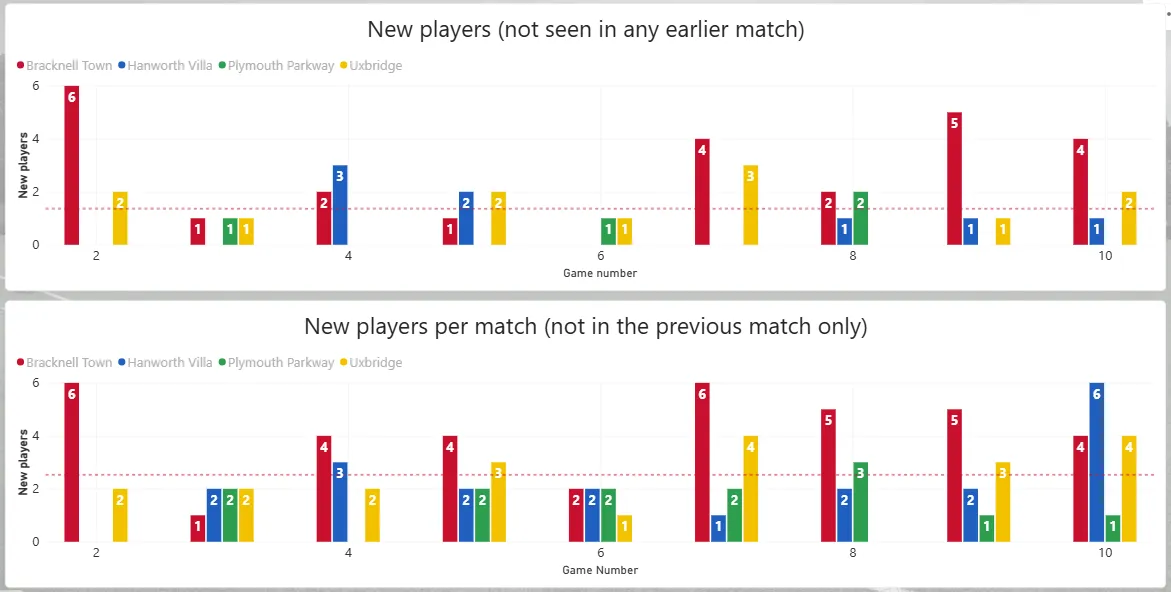
I’ve compared the same line-up changes with three different teams in the league to get a feel for the average line-up change as the season progresses. The red dotted line in the charts shows the average across the teams. The top chart shows Bracknell are way above average when introducing completely new players compared to their peers.
The story so far
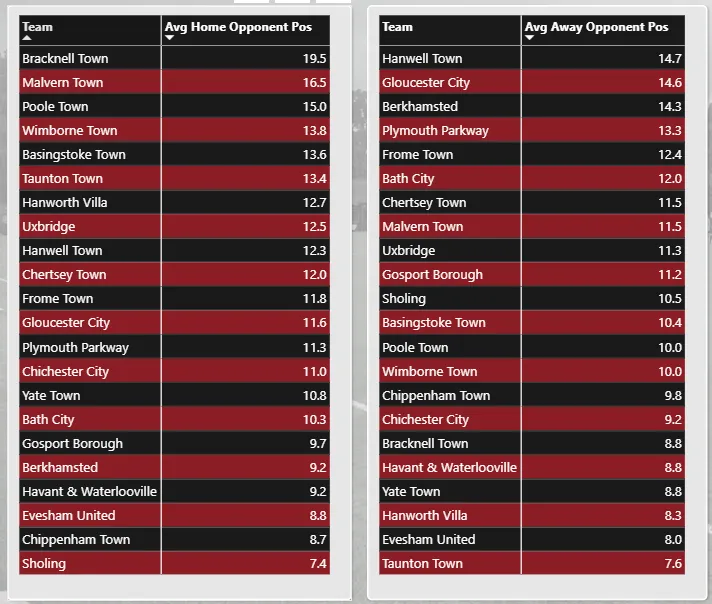
Examining the results in isolation paints a mixed picture, heavily influenced by the fixture computer. Bracknell have secured 3 wins, all at home. However, this coincided with the easiest home fixture list in the division, featuring opponents with an average league position of 19.5.
Conversely, away form has struggled mightily against tougher opposition, yielding 0 wins, 1 draw, and 5 losses on the road.
Goals
Goalscoring is at a poor 1.1 goals per game. This is the third lowest in the division. Defensive numbers are skewed by an opening-day 7-0 defeat at Plymouth Parkway, contributing to an average of 1.9 goals conceded per match (the sixth highest in the league) alongside just 1 clean sheet against bottom-of-the-table Malvern Town.
Points per game
A current return of 1.1 points per game projects to roughly 46 points over a 42-game season, a threshold historically associated with relegation battles in the division.
Potential long-term issues
What potential medium- to long-term issues could the large churn of players throw up? What factors outside of the club could affect the status quo?
Reputational damage
Social media is not real life, yet it highlights how sharply fans, both of Bracknell and rival clubs, have reacted with a mix of genuine dismay, banter, and outright ridicule toward the revolving door of players. Beyond the internet chatter, word travels fast through the football community; players talk to players and fans talk to fans. This persistent volatility inevitably raises wider concerns. Will parent clubs think twice before sending their prized young prospects out on loan to an unstable environment? Why would the parents of promising youngsters trust a development pathway at a club that seems more interested in buying players than in coaching them? Crucially, do established players want to risk leaving a stable position at another club to step onto such a volatile carousel?
Attendance and sustainability
Home attendances have dipped (see my article on attendances), with several matches falling below the 400 mark, a rare occurrence compared to previous seasons when only five matches dropped that low. In non-league football, gate receipts and matchday revenue form the financial bedrock of the club; persistent low turnouts directly strain the operational budget, limiting the players the club can afford to sign. Cup competitions may have provided more income, but Bracknell have gone out of two cup competitions at the first hurdle.
Fan detachment
With such a relentless churn of personnel, it becomes increasingly difficult for supporters to forge a meaningful connection with the team. I’ve personally found it very hard to connect to some of the games as I’m faced with another set of faces again and again.
Retention
Players get to choose to stay or leave. Early-season top scorer Ruben Bartlett-Antwi found the commute too far and Zaki left suddenly in September. If the strategy is to sift through the player pool to find gems then Bracknell have to keep those players happy when they find them. Also, successful players inevitably attract external interest, forcing the club to restart the recruitment cycle.
The well
A significant portion of last year’s squad quickly wound up at nearby rivals like Hanwell, Chertsey, Hanworth Villa, and Windsor and Eton, highlighting a clear geographic radius where players are willing to commute. But this implies a finite local well of players who possess the necessary quality and wage expectations for Bracknell. As the club burns through dozens of players in a single season, that local well risks running dry. Casting the net further afield only increases travel friction, leading straight back to the commuting problem described above. If all that remains to recruit are players who cannot get a game at peer clubs, it raises an obvious question: if they were not good enough for rivals, why are they good enough for Bracknell?
External pressures
Heavy hitters like Gloucester City and Havant & Waterlooville have hit rough patches, but their resources make a turnaround likely. An upturn in their form could drag Bracknell closer to the danger zone if away results do not improve.
Non-League is mad!
A counter to the whole question of player churn is… Non-League is mad in general. Jamal Sharpe has signed twice for us already this season! Poole’s managers left a team at the top of the table. Gloucester, who were flying last year, are rock bottom this year. Also, look at last season: rock bottom of the league, Matt Saunders going viral and Bracknell ended up finishing mid-table. It is entirely possible that the usual rules of football stability do not apply at this level and all the stats above could be meaningless by Christmas.
The takeaway
While the extreme player churn appears to be a deliberate strategy rather than an accident, the on-field return has yet to justify the disruption. Bracknell sit roughly where metrics on attendance, goals, and fixtures suggest they should. If the Robins are to climb away from relegation danger, stabilising the starting lineup and securing consistency over the next 10 games will be paramount.